So, you’ve been scrolling through Japanese auction listings at 2 AM again, haven’t you? We have all been there. You see a pristine Toyota Alphard, a legendary R34 Skyline, or perhaps a fuel-efficient Honda Fit Hybrid for a price that looks like an absolute steal compared to what’s sitting on a dealership lot in Sydney or Melbourne.
But before you hit “bid” or send a deposit to an offshore exporter, we need to have a serious chat.
Importing a car from Japan isn’t just about winning an auction and waiting for a boat. In 2026, the Australian import landscape is stricter than ever. Between the ROVER system, zero-tolerance asbestos testing, and the complex Specialist and Enthusiast Vehicle Scheme (SEVS), there are a dozen ways to lose your shirt if you don’t know the local rules.
In this exhaustive guide, we’re pulling back the curtain on the JDM car import process. No fluff, no sales pitch, just the cold, hard facts every Aussie needs to know before they spend a single dollar.
The “Golden Rule” of 2026: Is the Car Even Legal?
The biggest mistake Aussies make is buying a car that the Department of Infrastructure simply won’t let into the country. You can’t just bring in any old car because it’s cheap. To import a car from Japan, the vehicle must fit into one of these specific legal “pathways.”
The 25-Year Rule (The Collector’s Pathway)
As of 2026, any vehicle manufactured in 2001 or earlier is generally eligible for import under the “Older Vehicles” concessional pathway.
- The Specifics: Eligibility is calculated down to the month of manufacture. If a car was built in June 2001, it becomes eligible in June 2026.
- Modifications: The car should not have substantial modifications of less than 25 years of age. As a case in point, a Skyline (R32) with a current engine swap to a 2024 can be refused under this particular rule.
The SEVS Register (Specialist & Enthusiast Vehicle Scheme)
They should be registered on SEVS Register in case of cars that are less than 25 years old. This is for vehicles that offer something unique to Australia, think high-performance, environmental tech (hybrids), or mobility features (Welcabs).
- The Model Report Catch: Even if a car is on the SEVS list, you cannot import it unless an approved Model Report exists. This report is the technical blueprint used to ensure the car meets Australian Design Rules (ADR).
The Personal Import Scheme
If you’ve lived in Japan for more than 12 consecutive months and owned the car during that time, you might be able to bring it back. However, the 2026 rules require mountain loads of evidence regarding your residency and “intent to relocate permanently.”
Navigating the Japanese Used Car Auction System
The Japanese used car auction is a high-speed, high-stakes environment. To succeed, you must understand the “Auction Sheet”, the car’s medical record.
Decoding Auction Grades
| Grade | Meaning | Strategic Advice |
| S / 6 | Brand New | Rare and expensive; usually showroom stock. |
| 5 / 4.5 | Excellent | The “Sweet Spot” for quality imports. Minimal wear. |
| 4 | Good | Reliable daily drivers; expect minor cosmetic wear. |
| 3.5 / 3 | Average/Poor | Likely has rust, dents, or mechanical issues. Proceed with caution. |
| R / RA | Repaired | Has an accident history. Can be a bargain, but risky for resale. |
Japan Car Export Compliance
Before a car leaves ports like Yokohama or Osaka, it must clear Japan car export compliance. This includes obtaining the Export Certificate (Yushutsu Masho). In 2026, the Australian Border Force requires the original physical document. If this is lost in the mail, your car is effectively a very expensive garden ornament once it arrives in Australia.
The 2026 ROVER System: Your Digital Gatekeeper
Since the Road Vehicle Standards Act (RVSA) took full effect, all imports are managed through ROVER (Road Vehicle Regulator).
You must apply for a Vehicle Import Approval (VIA) before the car is loaded onto a ship. If a car arrives at an Australian port without a VIA, the Australian Border Force will not release it. You’ll be hit with storage fees (often $100+ per day) while you scramble for paperwork, and in many cases, the government may order the car to be re-exported or destroyed at your expense.
The “Hidden” Costs: A 2026 Financial Reality Check
The price you see in Japan is the FOB (Free on Board) price. Your “landed and complied” cost will be significantly higher.
Estimated Cost Breakdown (AUD)
- Ocean Freight: $3,500 to 6,500 (Ro-Ro would be less expensive; Container would be more secure).
- Import Duty: 5% of the Customs Value (5% in most cases, with Free Trade Agreements that Japanese-built cars are usually free, however, paperwork is needed).
- Importation GST: 10 percent is applied on (Value + Duty + Freight + Insurance).
- Luxury Car Tax (LCT): In the 2025-26 financial year, the limit is 80,567 (standard) and 91,387 (fuel efficient vehicles). Anything above this, 33% of any dollar is paid to the government.
- Asbestos Testing: $500 – $1,200. Australia has Zero Tolerance policy. In case your JDM legend of 1990s has asbestos gaskets or brake pads, they should be taken out of the car prior to it leaving the customs.
- Quarantine (DAFF): $500 – $1,500 to steam clean and examine exotic pests or seeds.
Right-Hand Drive Import Regulations & Compliance
While Japan and Australia both drive on the right, right-hand drive import regulations still require the car to be modified to meet Australian Design Rules (ADR).
This must be prepared by a Registered Automotive Workshop (RAW). In 2026, compliance includes:
- Safety Modifications: ADR approved tyres, seatbelt and child restraint anchorages.
- RAV Entry: The car is digitally entered into the Register of Approved Vehicles, which has replaced the old physical “compliance plates.”
- Emissions Testing: Ensuring the Japanese exhaust and engine specs meet 2026 Australian environmental standards.
Avoiding the “JDM Trap”: Scams to Watch For
The JDM market is currently booming, and that attracts “shonky” operators. Here is how to protect your “dollar”:
The Odometer Rollback
A car with 190,000km in Japan is suddenly listed with 70,000km for the Australian buyer. Always demand a History Check and verify the mileage on the original Japanese Export Certificate.
The “Salted” Chassis
Cars from northern Japan (Hokkaido) often suffer from severe underbody rust due to salted roads. Scammers often spray the undercarriage with black “deadener” to hide the rot. Always get an independent inspection before bidding.
The “Fake Exporter”
If the price looks 30% lower than everyone else and they only accept Western Union or Crypto, walk away. Legitimate exporters have a verifiable track record and usually work with established Australian brokers.
The Asbestos “Zero Tolerance” Policy (Crucial for 2026)
One of the quickest ways to lose your car is by ignoring the asbestos testing requirements. Australian border force (ABF) is very strict. Any vehicle produced prior to 2004 can be considered at high risk in 2026.
- Testing: Before the car leaves Japan, you should have the NATA-approved (or equivalent) lab test parts such as brake pads, clutch plates and gaskets.
- Certification: A simple letter from the seller saying “the car is clean” will not work. You need a formal lab report.
- Seizure: If asbestos is found at the Australian border, the car may be seized, and you will be fined. You’ll then have to pay for professional removal in a bonded warehouse, which can cost thousands.
Shipping: Ro-Ro vs. Container
When you import a car from Japan, you have two main choices for transport:
Roll-on/Roll-off (Ro-Ro)
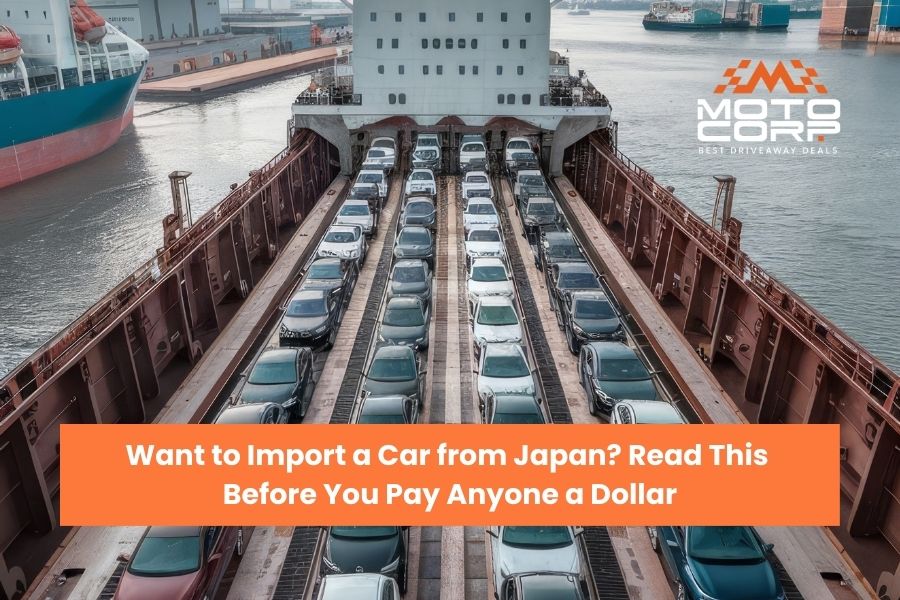
- How it works: Your car is driven onto a giant floating parking garage.
- Pros: Most cost-effective ($3,000 – $4,500).
- Cons: Car is exposed to the elements and port handling. Not suitable for non-running vehicles.
Container Shipping
- How it works: Your car is strapped inside a 20ft or 40ft steel container.
- Pros: Maximum protection from salt, air, and theft. Great if you import spare parts with the car.
- Cons: Expensive ($6,000 – $8,500). Requires specialized unloading at the port.
Top Japanese Cars to Import in 2026
If you’re looking for inspiration, these models are currently topping the “most wanted” lists for Australian ports:
- Family Luxury: Toyota Alphard & Vellfire (30 and 40 Series). These are the ultimate family “villas on wheels,” often arriving with features that blow local Odysseys or Carnivals out of the water.
- The Modern Icons: Nissan Skyline R34 (now fully 25-year legal) and the Mazda RX-7 FD. These are appreciating assets that are becoming harder to find in “Grade 4” condition.
- The Practical Adventurers: Mitsubishi Delica D:5. The ideal weekend getaway car in Australia, particularly the diesel 4WD models.
- The Environmentally Friendly Alternative: Toyota Crown Hybrid or a Honda Fit (Jazz) Hybrid. State-of-the-art, fuel economy, and unbelievably dependable.
The Logistics: Port to Driveway
After your car has passed through the customs and quarantine, it is not driving home.
- Port Pickup: To take the car off the wharf into the RAWs workshop, a special tow truck or a trade-plated transporter will be required.
- Compliance Phase: It may require 1 to 4 weeks based on the backlog of the workshop and part availability (such as ADR-spec tyres).
- Roadworthy & Registration: Once the car has been entered into the RAV database, you get it roadworthy (Blue Slip in NSW, RWC in VIC).
- Final Rego: You need to pay your stamp duty and registration fees at the local transport office, best bolt your new Aussie plates on, and you are finally ready to hit the road.
Why Partner with Moto-Corp?
You could try to navigate the ROVER portal, negotiate with Japanese shipping lines, and argue with customs brokers yourself. Or you could let the experts handle “heavy lifting.”
At Moto-Corp, we live and breathe the JDM car import process. We don’t just “buy cars”; we curate experiences.
- In-Country Inspections: We have boots on the ground in Japan to check for rust and mechanical issues before you bid.
- Total Transparency: We provide a full cost breakdown, so you know exactly what your “landed and complied” price is.
- ROVER Management: We handle the digital paperwork, so your car doesn’t get stuck in “Customs Limbo.”
- Asbestos Management: We ensure your car is tested and certified before it ever sees a ship, protecting your investment from seizure.
Conclusion
Importing a car is a high-reward game, but it’s not for the faint of heart. When you get it right, you end up with a high-spec, well-maintained Japanese icon that holds its value brilliantly in the Australian market. When you get it wrong, you’re stuck with a car you can’t register and a massive hole in your bank account.
Don’t risk your hard-earned cash on a “maybe.”
Whether you’re chasing a track-ready Godzilla or a high-spec family hybrid, doing it right the first time will save you thousands of dollars and months of headaches.
Stop guessing and start importing with confidence.
Contact the Moto-Corp team today for a 100% Free Eligibility Check on your dream car!
Leave a Reply